The Hims & Hers Lawsuit: The Marketing Conversation No One Is Having
The FTC lawsuit against Hims & Hers has reignited an important conversation within healthcare marketing. Since the news broke, I've seen thoughtful discussions about compliance, advertising regulations, patient privacy, and the legal responsibilities that come with marketing healthcare services.
Those conversations matter, and every healthcare organization should be paying attention.
What concerns me is where the conversation stops.
The overwhelming focus has been on avoiding legal risk—how to stay compliant, what disclosures are required, and what marketers should do differently moving forward. Those are necessary questions, but they address only one side of the challenge healthcare organizations now face.
Compliance was never intended to be a competitive advantage. It establishes the rules of the game, but it doesn't determine who wins. Once an organization has built a compliant marketing foundation, a different set of questions begins to emerge. How do you create a marketing system that continues to learn, improve, and perform in a world shaped by privacy regulations, AI-driven optimization, and increasingly fragmented customer journeys?
Those aren't compliance questions.
They're information questions.
And I believe they'll become the defining challenge for healthcare marketing over the next decade.

"Those aren't compliance questions. They're information questions."
Compliance Solved One Problem. It Exposed Another.
The healthcare industry has spent the past several years adapting to a new privacy landscape. Organizations have reviewed their tracking technologies, strengthened consent processes, implemented new governance practices, and invested in privacy-first measurement strategies. Those investments were both necessary and overdue.
At the same time, privacy regulations exposed something many organizations hadn't fully recognized: their marketing systems were already operating with incomplete information.
Long before pixels disappeared or regulations changed, many marketing teams struggled to connect advertising activity with meaningful business outcomes. Campaigns generated leads, but marketing platforms rarely knew which leads became qualified opportunities, scheduled appointments, or long-term patients. Executive teams were often forced to evaluate marketing performance using proxies because the outcomes that mattered most never made their way back into the systems responsible for future optimization.
Privacy didn't create that problem.
It simply made it much harder to ignore.
The organizations that adapt most successfully won't be the ones that find ways around privacy regulations. They'll be the ones that rethink how information moves through their marketing systems and begin intentionally closing the gaps that limit performance.

"Privacy didn't create information gaps. It made them impossible to ignore."
The Hidden Costs of Information Gaps
When I use the term information gaps, I'm not referring to missing reports or incomplete dashboards. I'm talking about the missing information that prevents marketing systems from understanding what success actually looks like.
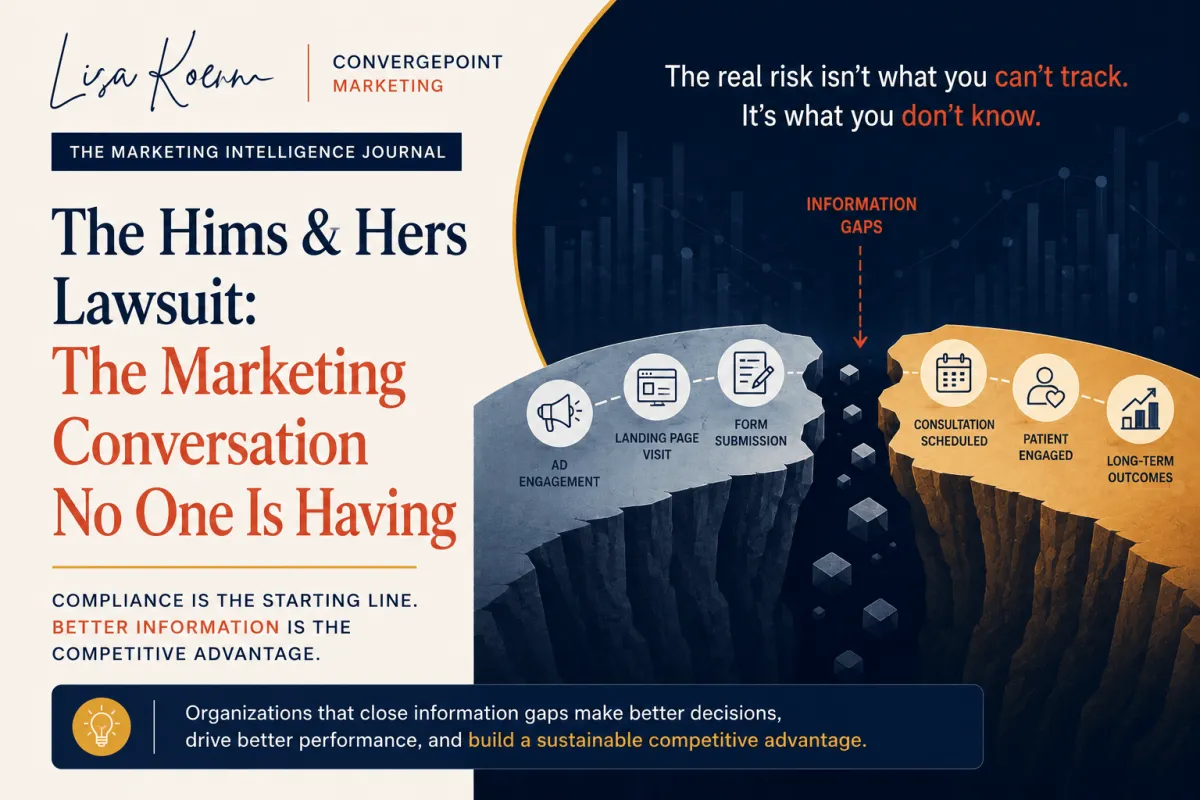
Consider a typical healthcare customer journey. A prospective patient may click an ad, read educational content, schedule a consultation, become a patient, and continue treatment for months or even years. At each stage, new information is created about that individual's intent, engagement, and long-term value. Yet much of that information never reaches the systems responsible for future marketing decisions.
As a result, advertising platforms optimize toward whatever they can see rather than what the business actually values. Attribution models tell only part of the story. Executive dashboards become disconnected from business outcomes. Marketing teams find themselves debating reports instead of making confident decisions.
This is why information gaps matter. They don't simply affect reporting; they shape the quality of every decision built on that information. When critical milestones, business outcomes, or customer signals are missing, the consequences extend far beyond analytics. They influence attribution, campaign optimization, budget allocation, executive confidence, and ultimately business performance.
Organizations often assume these are separate challenges. In reality, they're different symptoms of the same underlying problem: marketing systems are operating with an incomplete understanding of the customer journey.

Information Is Becoming the New Competitive Advantage
Marketing has always been about making better decisions than the competition. What has changed is who—or what—is making those decisions. Google determines which auctions to enter. Meta decides which audiences are most likely to convert. AI systems increasingly choose which creative to show, how aggressively to bid, and where budgets should be allocated.
The common assumption is that better algorithms produce better results. In reality, algorithms are only as effective as the information available to them. They cannot learn from customer journey milestones that were never captured, optimize toward business outcomes they never receive, or recognize patterns hidden behind disconnected systems. Their decisions are constrained by the quality and completeness of the information we provide.

That's why I believe healthcare marketing is entering a new phase. For years, the industry's focus has been on protecting information, and rightly so. Privacy regulations have fundamentally changed how organizations collect, process, and share data. But once those foundations are in place, the conversation must evolve. The next competitive advantage won't come from collecting more data. It will come from building better information.
There's an important distinction between those ideas. More data often creates more noise. Better information creates better decisions. Organizations that intentionally connect customer journey milestones, business outcomes, and marketing systems will give both their executives and their AI platforms something far more valuable than additional data—they'll provide context. And context is what improves attribution, strengthens algorithmic performance, and leads to better decisions over time.
"Organizations don't need more data. They need better information."
Stop Thinking About Data. Start Thinking About Information.
Most organizations invest heavily in collecting data. They add new platforms, implement new tracking technologies, and build increasingly sophisticated dashboards in the hope that more data will produce better decisions.
It rarely works that way.
Data, by itself, has very little value. Its value comes from the context it provides and the decisions it enables. Collecting more events doesn't automatically improve attribution. Capturing more page views doesn't make AI better at finding qualified patients. Building another dashboard doesn't fill the gaps between marketing activity and business outcomes.
The organizations making the biggest gains aren't necessarily collecting more data than everyone else. They're becoming more intentional about the information they create.
They ask different questions. Instead of asking, "What else can we track?" they ask, "What information is missing from the decisions we're trying to make?" Instead of measuring every interaction equally, they identify the moments in the customer journey that meaningfully change the probability of a successful outcome. Those moments become the information that guides attribution, strengthens optimization, and helps leadership make more confident decisions.
This is a subtle shift, but it's an important one. The objective isn't to build a larger dataset. It's to build a marketing system that continuously creates better information.
The Organizations That Pull Ahead Will Build Information Systems
The organizations that outperform over the next decade won't necessarily spend more on advertising, adopt AI faster, or implement the latest marketing technology before everyone else.
They'll have a deeper understanding of the information their marketing systems need to make intelligent decisions.
That's an important distinction because information isn't created by accident. It has to be intentionally designed into the customer journey.
Every meaningful interaction has the potential to become information. A patient downloading an educational guide tells you something different than scheduling an appointment. Completing a risk assessment reveals something different than attending a webinar. Becoming a long-term patient provides information that is fundamentally different from simply submitting a lead form.
Most organizations capture some of these moments. Very few ask whether they're capturing the right ones.
That's where strategy begins to diverge.
Instead of viewing measurement as a reporting function, leading organizations are beginning to view it as an information system. They aren't asking, "What happened?" They're asking, "What information will help us make better decisions tomorrow?"
That shift changes everything.
It changes how customer journeys are designed. It changes which milestones are measured. It changes what gets shared with advertising platforms, what executives see in their dashboards, and ultimately how AI systems learn over time. The objective is no longer to document the customer journey. It's to continuously improve the information flowing through it.
Organizations that embrace this mindset won't simply understand marketing performance more clearly. They'll create a marketing system that becomes smarter with every meaningful interaction.
"Marketing isn't just a campaign system. It's an information system."

The Conversation That Starts After Compliance
The FTC lawsuit against Hims & Hers should prompt every healthcare organization to revisit its compliance practices. That's an important outcome, and one the industry should take seriously.
But I hope it prompts something else as well.
I hope it encourages marketing leaders to look beyond compliance and ask a more strategic question:
What information is our marketing system still missing?
That's the conversation I don't see enough organizations having.
Not because compliance isn't important. It is.
But because compliance was never intended to answer every marketing question. It establishes the boundaries. It defines what's permissible. It creates the foundation on which everything else is built.
What organizations build next will determine how effectively they compete.
The healthcare organizations that lead over the next decade won't be the ones that collect the most data or deploy the most AI. They'll be the ones that intentionally build marketing systems capable of creating better information—information that improves attribution, strengthens algorithmic performance, increases executive confidence, and ultimately leads to better business decisions.
The Hims & Hers lawsuit reminded the industry why compliance matters.
The next conversation begins where compliance ends.
Compliance is the starting line. The future belongs to organizations that intentionally build better information.
"The future belongs to organizations that intentionally build better information."
About the Author:
Lisa Koenn is the founder of ConvergePoint Marketing, where she helps healthcare organizations close information gaps through marketing intelligence, measurement architecture, attribution, and AI-ready marketing infrastructure.
